


Pai Gow Poker and How the Two-Hand Game Really Works
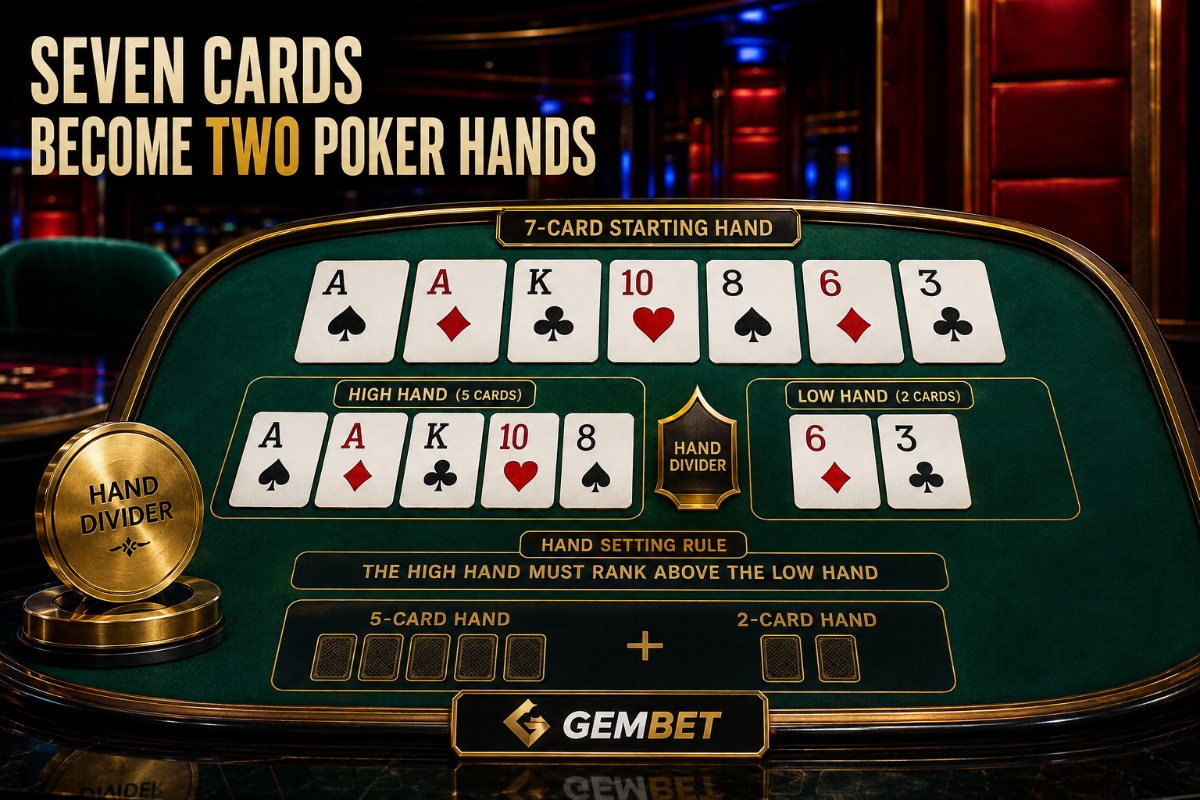
Pai gow poker is a casino card game where seven cards are divided into two separate poker hands: a five-card High Hand and a two-card Low Hand. Both hands are then compared with the dealer’s corresponding hands. To win the round outright, the player normally needs to beat the dealer in both comparisons. Winning one and losing one commonly creates a push.
The unusual two-hand structure is what makes the game different from most casino poker formats. Instead of trying to build one strongest possible hand, the challenge is deciding how to divide seven cards without making the two-card hand stronger than the five-card hand.
Pai gow poker in one quick table
| Game element | What it means |
|---|---|
| Starting cards | Seven cards |
| High Hand | Five-card poker hand |
| Low Hand | Two-card poker hand |
| Main objective | Beat both dealer hands |
| One win and one loss | Commonly a push |
| Joker | Used according to special Pai Gow rules |
How does pai gow poker work?
Pai gow poker begins with seven cards that must be separated into a five-card High Hand and a two-card Low Hand. The High Hand must rank higher than the Low Hand.
After the player’s cards are set, the dealer also forms two hands. The comparisons are then:
- Player High Hand versus dealer High Hand
- Player Low Hand versus dealer Low Hand
The result depends on whether the player wins both comparisons, loses both, or splits them.
The five-card hand is called the High Hand
The High Hand uses standard five-card poker rankings.
Depending on the rules, this can include:
- Royal Flush
- Straight Flush
- Four of a Kind
- Full House
- Flush
- Straight
- Three of a Kind
- Two Pair
- One Pair
- High Card
This hand must remain stronger than the two-card Low Hand after the seven cards are divided.
The two-card hand has fewer possible rankings
The Low Hand contains only two cards, so it can normally be either:
- A Pair
- Two unmatched cards ranked by the higher card
For example:
A♣ 9♦ = Ace-high
7♠ 7♥ = Pair of Sevens
A pair normally beats any non-pair two-card hand.
The High Hand must stay stronger than the Low Hand
This rule is central to pai gow poker.
Suppose the seven cards allow you to create:
High Hand: Pair of Tens
Low Hand: Pair of Queens
That arrangement is invalid because the two-card Low Hand is stronger than the five-card High Hand.
The hands need to be rearranged so the five-card side ranks higher.
This is sometimes called fouling the hand
Setting the Low Hand stronger than the High Hand is commonly described as fouling or mis-setting the hand.
The exact consequence depends on the table rules, but it can result in the hand losing.
Digital versions often prevent invalid arrangements by warning the player before the hand is confirmed.
Even so, understanding the rule helps explain why the interface may reject a particular split.
Seven good cards do not automatically make two winning hands
Pai gow poker requires balance.
Suppose you receive several strong cards. Putting every premium card into the High Hand might create an excellent five-card combination but leave the Low Hand extremely weak.
Moving one strong card into the two-card side can improve the Low Hand while slightly weakening the High Hand.
The challenge comes from creating two legal pai gow hands from the same seven cards.
To win, both hands normally need to beat the dealer
Consider this simplified example:
Player High: Pair of Kings
Dealer High: Pair of Queens
The player wins the High Hand.
Now compare:
Player Low: Ace-9
Dealer Low: King-10
The player also wins the Low Hand.
Winning both comparisons produces an overall player win under standard settlement logic.
Winning one hand and losing one can create a push
The split nature of pai gow poker is why pushes are common.
For example:
Player High: Pair of Kings
Dealer High: Pair of Queens
Player wins High.
But:
Player Low: 9-7
Dealer Low: A-8
Dealer wins Low.
The result is commonly a pai gow push, meaning the main wager is returned rather than winning or losing.
Losing both hands loses the main wager
If the dealer beats the player’s High Hand and Low Hand, the main wager normally loses.
Example:
Player High: Pair of Tens
Dealer High: Pair of Jacks
Dealer wins High.
Player Low: Queen-8
Dealer Low: King-5
Dealer wins Low.
Because both comparisons go to the dealer, the player loses the round.
Dealer ties can matter
One of the rules that can surprise new players is how exact ties are handled.
In many Pai Gow Poker formats, an exact tie between a player hand and the corresponding dealer hand is awarded to the dealer.
This can affect an otherwise close round.
Because table rules can vary, check the specific game information before playing rather than assuming a tied five-card or two-card hand always pushes.
The joker does not usually act as a completely wild card
Pai gow poker often uses a 53-card deck containing one Joker.
The Joker commonly has restricted uses rather than substituting for absolutely any card.
Depending on the rules, it may be used to complete:
- A Straight
- A Flush
- A Straight Flush
When it is not needed for one of those combinations, the Joker may behave as an Ace.
Always check the current table rule because Joker treatment is an important part of hand setting.
A Joker can change how the seven cards should be divided
Suppose the player has four cards to a Flush plus the Joker.
Using the Joker in the High Hand may complete the Flush.
But the other two cards may then create a weak Low Hand.
Another arrangement could produce a lower-ranked High Hand but a stronger pair in the Low Hand.
This illustrates why the best-looking five-card combination is not automatically the only consideration.
Pairs create many of the important hand-setting decisions
Imagine the seven cards contain two separate pairs.
The player may have to decide whether to:
- Keep both pairs together in the High Hand
- Split the pairs between High and Low
- Use one pair as the Low Hand
The correct legal arrangement depends on the remaining cards and table strategy.
The game is therefore less about drawing additional cards and more about how the existing seven are organised.
Three pairs create even more combinations
A seven-card deal containing three different pairs can be arranged in several ways.
For example:
- Pair of Kings
- Pair of Nines
- Pair of Fours
- One extra card
One arrangement could place two pairs in the High Hand and one pair in the Low Hand.
Another arrangement could preserve a stronger five-card combination depending on the complete cards.
This is one reason the table may offer an automatic or house-way setting option.
What is the house way?
The house way is a predefined method used by the casino to arrange the dealer’s seven cards.
Some electronic versions can also offer players an option to arrange their cards according to a recommended house-style method.
The house way is not a guarantee of winning. It is simply a consistent rule set for dividing particular combinations.
Players who want to understand the game more deeply can compare the suggested split with other legal arrangements before confirming.
Pai gow poker plays more slowly than many casino games
Each round involves dealing seven cards, arranging two hands, revealing the dealer cards, and making two separate comparisons.
Pushes can also return the main wager without producing a win or loss.
These characteristics often make the game feel slower than a fast electronic table or slot.
The pace itself does not change the mathematical outcome, but it can affect how much total wagering occurs during a session.
Commission may apply to winning bets
Traditional pai gow poker can apply commission to winning main wagers.
A fictional example with a 5% commission on S$100 profit would be:
S$100 × 5% = S$5 commission
S$100 − S$5 = S$95 net profit
The original stake is then returned as part of the total settlement.
Some modern variants can use different payout structures, so the current paytable should be checked before assuming commission applies.
Side bets are separate from the two-hand result
Selected Pai Gow Poker tables may offer side bets based on the seven-card combination.
These can pay for strong arrangements such as:
- Three of a Kind
- Straight
- Flush
- Full House
- Four of a Kind
- Straight Flush
A side bet can be settled independently from whether the player’s two final hands beat the dealer.
That means a player can win a bonus wager while the main hand pushes or loses.
Side bets increase the full amount committed
Suppose the main wager is S$20 and an optional side bet is S$5.
The total amount placed is:
S$20 + S$5 = S$25
If the main hand pushes but the side bet loses, the player does not finish the round completely unchanged because the S$5 side wager was settled separately.
Track every betting area rather than thinking only about the main table wager.
Pai gow poker is different from Three Card Poker
Players who read the previous Gembet article about three card poker will notice that both games use poker rankings, but the structure is very different.
| Feature | Pai Gow Poker | Three Card Poker |
|---|---|---|
| Cards received | Seven | Three |
| Player hands | Two | One |
| Main decision | How to split the cards | Play or Fold |
| Dealer comparison | Two separate hands | One three-card hand |
The shared poker terminology should not make the games seem interchangeable.
Why are pushes common in pai gow poker?
Pushes are common because the player must win two separate hand comparisons to win the main wager outright.
Winning only the five-card side while losing the two-card side can return the main stake.
The same applies when the Low Hand wins but the High Hand loses.
This split settlement is a defining feature of the game and explains why the pace can feel different from casino tables where every round produces a clear win or loss.
Mobile play needs a clear hand-setting interface
Seven cards can become crowded on a smaller screen, so mobile versions should make it easy to move cards between the two hands.
Before confirming, check that you can clearly see:
- All seven cards
- The five-card High Hand
- The two-card Low Hand
- The total stake
- Any side wagers
- The confirm button
- The dealer’s final hands
A good interface should also warn if the two hands are arranged illegally.
Gembet players should check the exact table variant
When Pai Gow Poker is available in the Gembet casino lobby, open the individual game’s rules before applying assumptions from another version.
Check:
- How ties are handled.
- Whether winning bets pay commission.
- How the Joker works.
- The hand-ranking rules.
- Whether a house-way option is available.
- Any side-bet paytables.
- Minimum and maximum stakes.
- How invalid hand settings are handled.
Those details can change the settlement even when the basic two-hand concept stays the same.
Understand both hands before judging the round
Pai gow poker becomes much easier to follow once the seven-card deal is treated as two separate comparisons rather than one large poker hand.
The five-card High Hand must remain stronger than the two-card Low Hand. The player then needs both pai gow hands to beat their dealer counterparts for a normal outright win, while splitting the comparisons commonly produces a pai gow push.
The most important checks are the hand-setting rule, Joker treatment, dealer tie rule, commission structure, and optional side bets. Once those are clear, the unusual seven-card layout becomes one of the more straightforward casino poker formats to read.
Experience the real deal with SG's top Live Dealers. Play Baccarat, Roulette & more.

