


Sports Betting Fixture Timing: Compare Markets at the Right Moment
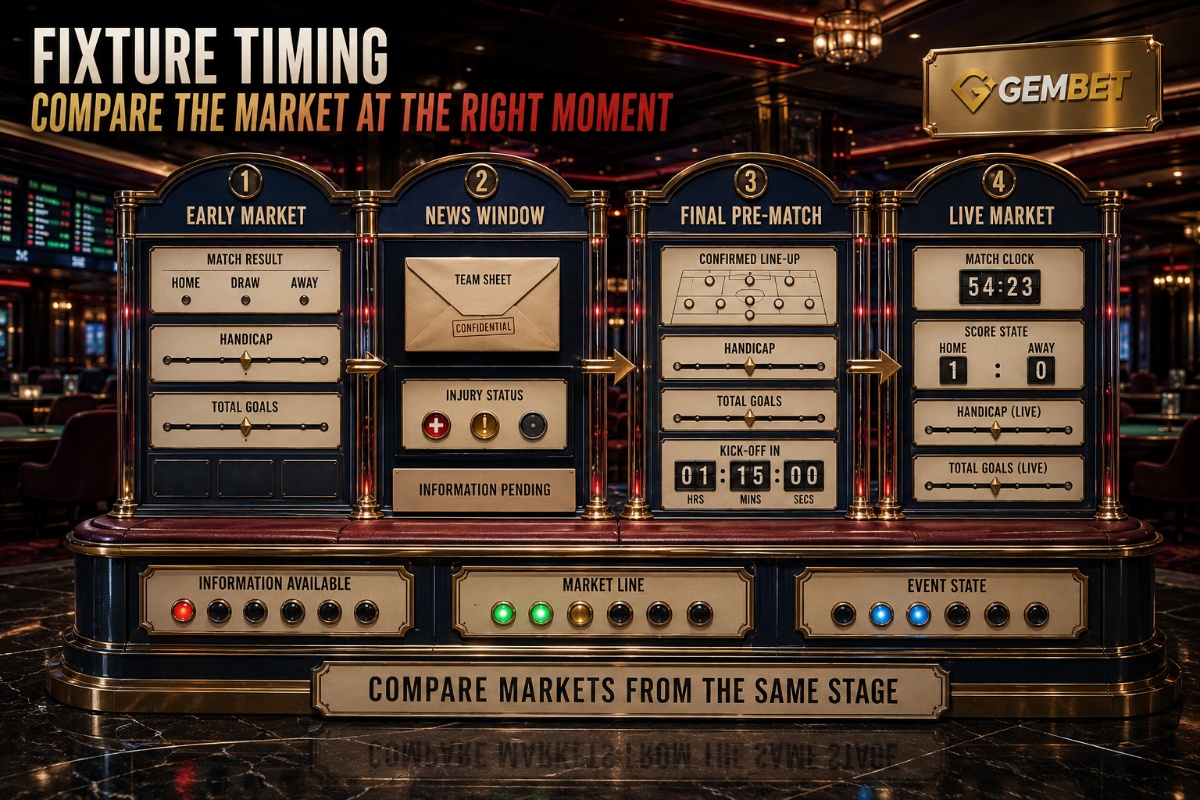
Fixture timing changes what a betting market can tell you. The same match may look simple three days before kick-off, less certain after an injury update, and different again once the confirmed line-up appears. Comparing markets without checking when each price was viewed can make unlike information look comparable.
This guide explains how fixture timing affects market depth, line movement, team-news relevance and the usefulness of pre-match versus live options. The aim is not to predict movement. It is to compare markets at the stage when the information they need is actually available.
Fixture Timing Creates Different Versions of One Market
A match-result market opened early in the week is not the same decision as the market shown one hour before kick-off. The names may be identical, but the available information may have changed.
Fixture timing divides the event into five practical stages:
- early listing, when information may be incomplete;
- midweek review, when schedule and form context are clearer;
- team-news window, when availability matters more;
- final pre-match period, when details should be confirmed; and
- live play, when score, clock and game state create new markets.
Compare prices and market types within the same stage whenever possible. An early total and a final pre-match total may use different lines and information.
Early Markets Offer Time but Less Detail
Fixture timing gives early listings enough time to study the competition, rest days, travel, recent opponents and likely tactical match-up. The trade-off is that fewer supporting markets may be available.
Player props, detailed period markets and team-specific options often depend on expected participation. Availability varies by sport and platform.
Fixture timing changes the correct question. Early in the week, broad markets such as match result, handicap and totals may be easier to compare. Closer to the event, participant-specific options may become more assessable.
Market Depth Is Not Market Quality
Fixture timing can make a large menu appear more useful, but more choices do not automatically mean better choices. A market matters only when the player understands its period, settlement condition and information requirements.
Fixture timing can explain why one match has basic options while another has many props. The difference may reflect the sport, competition, expected interest or how close the event is to starting.
Compare whether the available markets fit the information currently known. A short list of understood options is more useful than dozens of late-added selections tied to uncertain participation.
Team News Changes Which Markets Compare Fairly
A missing striker may matter more to team-goal or player-shot markets than to a broad match-result market. A basketball player’s status may affect points, assists, rebounds and team totals differently.
Fixture timing helps players wait for the information a market needs. If a comparison depends on a named player starting, reviewing that prop before participation is reasonably clear creates an avoidable gap.
Write one information requirement beside each shortlisted market:
- match result: overall strength, venue and likely availability;
- totals: pace, scoring profile and major absences;
- player prop: participation, role and likely minutes;
- first-half market: starting approach and early-game pattern;
- live market: score, time remaining and visible game state.
This makes fixture timing part of market selection rather than a last-minute reminder.
Compare the Line, Not Only the Price
Fixture timing matters because players often notice changing odds but overlook that the line moved too. Over 2.5 and over 3.0 are not direct price comparisons because the required outcome changed. The same applies to a handicap moving from -0.5 to -1.0.
Fixture timing can create a new version of the market. Record both the line and price at the time of review. Without both, a later comparison may be misleading.
Use a Market Snapshot
A snapshot makes fixture timing visible. Record:
- date and local time checked;
- event start time;
- market name and period;
- selection, line and displayed price;
- important information still missing; and
- the next review time.
Place two snapshots side by side. You can then see whether the price changed, the line changed, the market disappeared or new information arrived.
This does not prove why a market moved. It prevents an explanation from being invented after the fact.
Later Is Not Automatically Better
Waiting until the final pre-match window can provide more information, but it also leaves less time for careful comparison. Some markets may close or change quickly.
Fixture timing should match the market’s information needs. Broad markets can be reviewed early and checked again. Participant-dependent markets may deserve a later first review. Live options should not replace unfinished pre-match research.
The useful moment is when enough relevant information exists and enough time remains to read the rules calmly.
Kick-Off Order Can Change Incentives
Two fixtures in the same competition may not be equally comparable when one starts earlier. A later match may be affected by results already known elsewhere.
In group stages, qualification races and playoff scenarios, fixture timing can change what a team needs from a draw, winning margin or total. Ask whether the participants already know a result that changes their objective. That does not mean their response is predictable.
Simultaneous Fixtures Require Priorities
When several matches start together, following every market live is unrealistic. Use fixture timing to choose one priority event before the group begins. Other matches can remain context only.
Confirm that all selected events use the same local time reference. A conversion error can turn a planned review into a rushed decision.
Period Markets Depend on Exact Format
First-half, quarter, set, map and inning markets are tied to smaller time segments. Before comparing them, understand what counts within that period and how settlement works.
Fixture timing matters because these markets may appear closer to the event. The scheduled format must also be confirmed. A best-of-three tennis match differs from a best-of-five match, while basketball competitions may use different quarter or overtime rules.
Verify both the event format and market period before comparing prices.
Live Markets Compare Game States
Fixture timing separates a pre-match market, which compares expectations before play. A live market reflects score, elapsed time and remaining opportunity. The same team can appear in both, but the decision context is different.
Fixture timing makes this distinction unavoidable. A live total after an early goal cannot be compared directly with the original total unless line, price, time and score are all recorded.
A pre-match opinion should not automatically justify a live wager. The live market needs its own reason and stopping rule.
Use Gembet as the Final Timing Check
On Gembet, the event page can be used to recheck the scheduled start, competition, participants, market period and current status. Availability and layout may vary, so use the live interface rather than assumptions.
Compare the Gembet listing with the personal snapshot. Confirm that the line has not changed, the fixture has not moved and the market still covers the intended period.
If wording or status is unclear, pause and reopen the rules instead of relying on memory.
A Four-Window Fixture Timing Method
Window 1: Map the Event
Confirm the competition, venue, scheduled format and local start time. Shortlist broad markets that do not require final team news.
Window 2: Update the Information
Review injuries, rest, travel, rotation risk and competition incentives. Remove markets that still depend on unresolved details.
Window 3: Complete the Final Check
Confirm participants, line-ups where relevant, current line, price and settlement wording. Do not add a complex market simply because it appeared late.
Window 4: Review After Settlement
Compare the final snapshot with the settled result. Judge whether the chosen market matched the information available at the time, not whether hindsight makes another option look better.
This fixture timing method teaches an important distinction: market comparison is about decision quality at a specific moment, not finding the best-looking price after the event.
Common Errors That Distort Comparisons
- comparing prices while ignoring a changed line;
- reviewing player props before participation is known;
- assuming more late markets means better information;
- using a pre-match view to justify an unrelated live selection;
- missing a rescheduled start or changed venue;
- mixing events shown in different time zones; and
- treating movement as proof of a future result.
Fixture timing cannot remove uncertainty, but it can remove avoidable comparison errors.
What Fixture Timing Teaches Market Comparers
Fixture timing shows that a betting market is not fixed. Its line, price, depth and relevance can change as the event approaches and new information appears.
The practical lesson is to compare like with like: early markets with early markets, final pre-match options with confirmed context, and live markets with the current game state.
Use Gembet only after the event, period, line and start time are checked. Keep the wager within a fixed entertainment budget and do not extend the session simply because another market opens later.
A fixture timing check succeeds when it helps reject weak comparisons. It should show why one market can be assessed now, why another should wait and why some options should be skipped entirely.
Experience the real deal with SG's top Live Dealers. Play Baccarat, Roulette & more.

