


99% RTP Slots vs High Volatility Slots: Which Should You Choose?
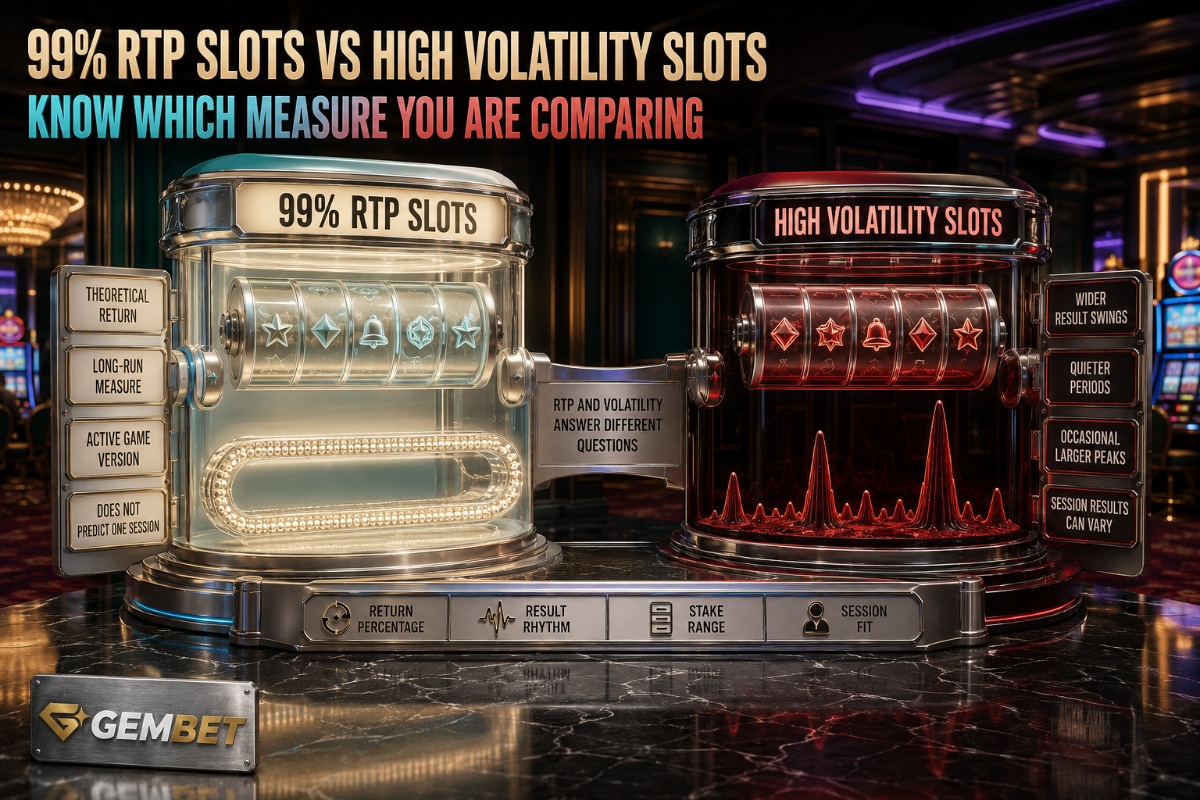
99% RTP slots attract attention because the percentage appears to offer a simple way to rank games. High volatility slots attract a different type of attention because they may concentrate more of their potential in less frequent outcomes. These labels are often compared as though they describe the same thing, but they measure different parts of a slot.
RTP estimates theoretical return across extensive play under the stated configuration. Volatility describes how unevenly results may be distributed. Neither figure predicts the next spin, guarantees a profitable session or removes the need to check the stake, rules and feature structure.
99% RTP Slots and High Volatility Measure Different Things
99% RTP slots describe games with a theoretical return of approximately 99% under the active rules and configuration. In simplified terms, the model is designed to return an average of 99 units for every 100 wagered across a very large number of rounds.
That does not mean a player who stakes £100 will receive £99 back. A short session can finish above or below the theoretical percentage because actual results do not arrive in a smooth sequence.
High volatility slots describe the distribution of results rather than the long-run percentage. They may produce longer quiet periods, wider balance movements and a greater concentration of value in less common features or symbol combinations.
Use a Two-Axis Comparison
Instead of placing 99% RTP slots at one end and high volatility slots at the other, imagine two separate axes.
- RTP axis: lower theoretical return to higher theoretical return.
- Volatility axis: steadier result distribution to more uneven result distribution.
A game can sit high on both axes. It can have a 99% theoretical return and still be highly volatile. Another title may have a lower RTP but a steadier result rhythm.
This is the first important lesson: 99% RTP slots are not automatically low-volatility games.
Why a 99% Figure Can Be Misread
Players may see 99% RTP slots and assume that only 1% of their session is at risk. That interpretation is incorrect because RTP is not a session-loss limit.
The percentage is calculated over a much larger sample than an individual normally plays. It includes the full mathematical design, which may contain rare features, multipliers or maximum wins that most short sessions will never encounter.
Before prioritising 99% RTP slots, verify:
- whether 99% is the active configuration;
- whether the percentage applies only to a particular mode;
- whether a higher stake or special feature is required;
- whether the figure includes a jackpot contribution; and
- whether the provider offers several RTP versions.
A High RTP Does Not Describe the Journey
Two 99% RTP slots can feel completely different. One may create frequent small outcomes in the base game. Another may reserve a large share of its theoretical return for an infrequent bonus round.
The percentage does not reveal:
- how often winning combinations occur;
- how often bonuses trigger;
- how large ordinary wins tend to be;
- how long quiet periods may last; or
- how quickly the balance may move during one session.
These are volatility and game-structure questions rather than RTP questions.
What High Volatility Looks Like in Practice
High volatility slots may produce several rounds with little activity followed by a larger feature or combination. The exact pattern differs by game, and a larger outcome is never guaranteed to arrive before the session ends.
A player using high volatility slots may experience:
- longer periods without a meaningful feature;
- greater dependence on free spins or special symbols;
- wider balance changes over a small number of rounds;
- stronger temptation to raise the stake during quiet periods; and
- more emotional pressure from near-trigger animations.
The main challenge is not simply losing more quickly. It is maintaining the original stake and stopping point when the game produces little visible activity.
Four Game Profiles Explain the Difference
High RTP and Lower Volatility
This profile may offer a comparatively high theoretical return with a steadier distribution. It can suit players who prefer more regular activity, but frequent small outcomes may encourage longer sessions if they are mistaken for progress.
High RTP and High Volatility
These 99% RTP slots may have attractive mathematics over extensive play while still producing large short-term swings. A significant amount of theoretical value may sit inside rare features.
Lower RTP and Lower Volatility
This profile may feel active during ordinary play even though the theoretical return is lower. A smoother experience does not compensate for a less favourable long-run percentage.
Lower RTP and High Volatility
This combination offers both a lower theoretical return and a more uneven result pattern. It requires particular caution because dramatic features can distract from the underlying percentage.
Calculate Session Exposure Before Comparing Labels
A player choosing between 99% RTP slots and high volatility slots should calculate the planned exposure first.
Planned exposure = stake per spin × maximum number of spins
A £0.20 stake across 100 spins creates £20 of total wagering activity, although individual wins may be reused during the session. A £1 stake across the same number of spins creates £100 of turnover.
This calculation is more useful for short-term planning than assuming a 99% RTP will control the final result.
Round Speed Can Matter More Than the Headline
A title with rapid animations, turbo mode or short result sequences can complete far more spins within the same period. Even 99% RTP slots can create substantial turnover when played quickly.
Compare:
- stake per spin;
- average spins per minute;
- planned session length;
- autoplay settings where available; and
- whether cascades count as part of one paid round.
A slower high-volatility game may still create wide swings, while a faster high-RTP game may use the budget more quickly than expected.
Feature Dependence Changes the Meaning of RTP
Some 99% RTP slots achieve their theoretical percentage through ordinary combinations. Others rely heavily on free spins, respins, progressive multipliers or a rare top feature.
Open the paytable and ask where the game’s potential appears to be concentrated. Look for:
- bonus-trigger requirements;
- retrigger rules;
- multiplier progression;
- maximum-win conditions;
- feature-buy modes; and
- separate RTP settings for enhanced play.
If the main appeal depends on one rare bonus, the practical experience may resemble high volatility slots even when the RTP headline is strong.
Bonus Buys Can Change the Comparison
A feature-buy option may provide direct entry to a bonus at many times the ordinary stake. Some games display a different RTP for that mode, while others change volatility or feature conditions.
Do not compare standard-mode 99% RTP slots with high volatility slots in bonus-buy mode as though they have equal costs. Record the purchase price, active RTP, feature version and maximum-win rule separately.
Direct access removes the wait for a natural trigger. It does not guarantee that the feature returns its purchase cost.
Match the Game Profile to the Session
99% RTP slots may suit a player who prioritises theoretical return and is willing to verify the active configuration. High volatility slots may suit someone who understands that much of the activity can be concentrated in less frequent outcomes.
Neither description is enough on its own. Match the game to these questions:
- How many spins are planned?
- What fixed stake can be maintained?
- Would a long quiet period create pressure to continue?
- Is the main feature easy to understand?
- Can the session end without the bonus appearing?
If the answer to the last question is no, high volatility slots are a poor fit for that session.
Check the Active Version on Gembet
When reviewing 99% RTP slots on Gembet, open the game information panel and confirm the percentage shown for the active version. Do not rely entirely on an external review, provider summary or search result because another configuration may be described.
Then check whether Gembet displays volatility, stake limits, feature rules and enhanced modes. When a volatility rating is unavailable, the paytable and bonus concentration can provide context, but they should not be treated as an exact substitute.
Common Choice Errors
Players commonly make the following mistakes when comparing 99% RTP slots and high volatility slots:
- assuming 99% means receiving 99% back in one visit;
- treating high RTP as proof of low volatility;
- choosing volatility from artwork or animation alone;
- ignoring the active game configuration;
- raising the stake to make a quiet game feel more active;
- continuing until a bonus appears; and
- switching games because one is believed to be “due”.
Changing titles does not reset the budget or improve the probability of the next result.
Questions Players Often Ask
Are 99% RTP slots always the best choice? No. They offer a stronger theoretical percentage than many alternatives, but stake range, volatility, feature dependence and session speed still matter.
Do high volatility slots pay more? They may concentrate value in less frequent outcomes, but they do not guarantee larger returns during a particular session.
Can one game be both high RTP and high volatility? Yes. The two labels measure different characteristics.
Is low volatility safer? No slot is risk-free. Lower volatility may reduce the size of typical swings, but spending and session length still need limits.
Does playing longer make the RTP apply to me? No specific number of spins guarantees that an individual result will match the theoretical percentage.
Choose the Measure That Answers Your Real Question
99% RTP slots answer a long-run mathematical question: what theoretical return does the active configuration provide across extensive play? High volatility slots answer a distribution question: how unevenly might the game deliver its outcomes?
Choose 99% RTP slots when theoretical return is a priority, but verify the exact version and do not expect the percentage to control a short session. Choose high volatility slots only when wider swings, quiet periods and feature dependence can be accepted without raising the stake or extending the limit.
The strongest choice may be a game that balances both measures with clear rules, an affordable stake and a pace that fits the planned session. Gembet can serve as the final rule and configuration check, but the budget and stopping point should be decided before the first spin.
High RTP slots with instant 100% Welcome Bonus. Spin & Win big today!

