


21+3 Blackjack With Expert Side-Bet Tips to Avoid Costly Errors
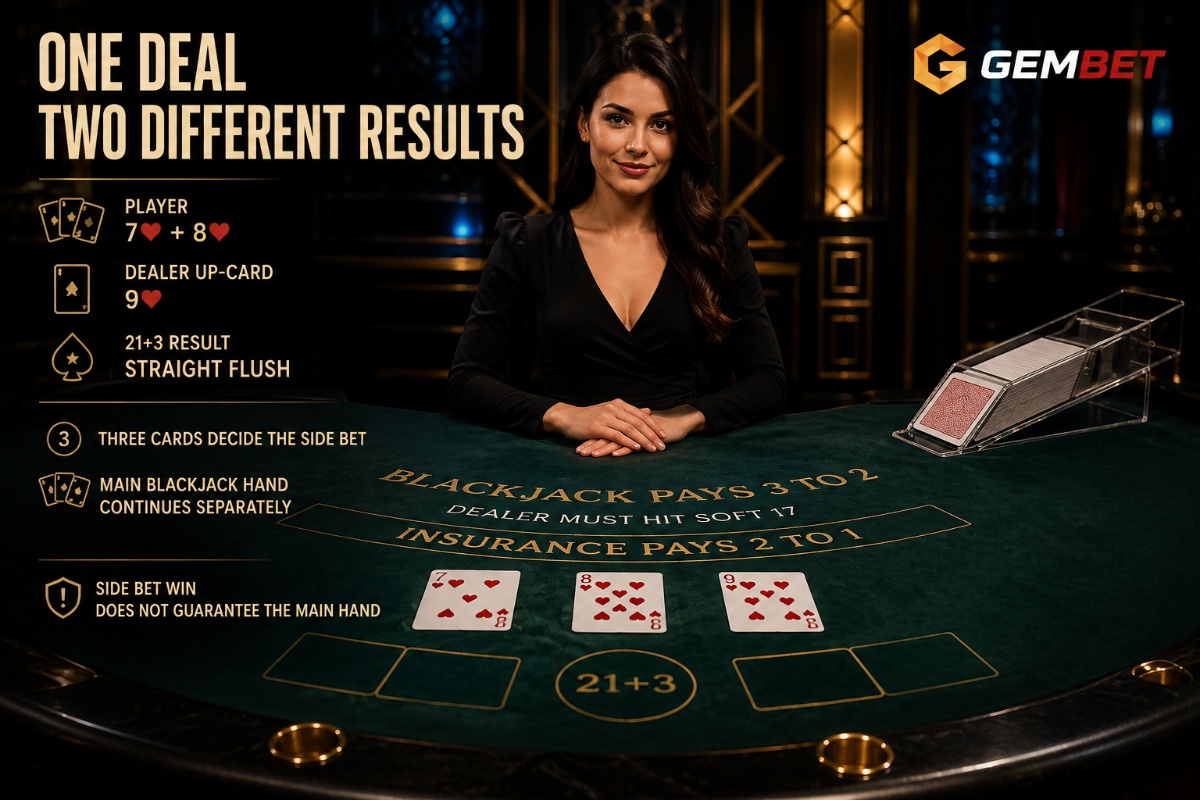
21+3 blackjack adds a poker-style side wager to the opening deal of blackjack. The main hand still follows the normal objective of beating the dealer without going over 21, but the blackjack side bet looks only at your first two cards and the dealer’s up-card. At Gembet, the useful way to approach 21+3 blackjack is to treat it as a separate bet with its own paytable, probability and settlement. A strong side-bet result does not change whether the main blackjack hand wins.
Why 21+3 blackjack feels different from ordinary blackjack
The attraction is that one deal creates two separate outcomes. Your blackjack hand continues after the opening cards, while the side wager is normally decided immediately from three cards. That makes 21+3 blackjack faster to resolve than the main hand and gives poker-style combinations a role at a blackjack table.
The three cards are your first card, your second card and the dealer’s visible up-card. Hitting, standing, splitting or doubling later does not improve the side wager because those later cards are not part of it.
The five poker-style combinations to recognise
| Combination | What the three cards need |
|---|---|
| Flush | All three cards share one suit |
| Straight | Three consecutive ranks |
| Three of a Kind | Three cards share the same rank |
| Straight Flush | Three consecutive ranks in one suit |
| Suited Three of a Kind | Same rank and same suit across multiple decks |
These combinations can produce larger posted returns than an ordinary even-money blackjack win. The rarer the qualifying hand, the more important it is to compare payout with probability.
A simple 21+3 blackjack example
Suppose your first two cards are 7♥ and 8♥ and the dealer shows 9♥. Those three cards create a straight flush for the side wager. The 21+3 blackjack result is already determined from that opening combination. Your main blackjack hand, however, is only 15 and still needs its own decision under the table rules.
This separation is important. Winning the side wager does not automatically win the blackjack hand, and losing the side wager does not prevent the main hand from winning.
Seven checks before adding the side wager
- Check that the table actually offers it. Not every blackjack table includes the same optional bets.
- Read the paytable. Different versions can pay different amounts for the same poker-style hand.
- Confirm which three cards count. It is normally your first two cards plus the dealer’s up-card.
- Keep the side stake separate. The optional wager increases the amount at risk on the same deal.
- Do not use later blackjack decisions to judge it. The 21+3 side bet is already settled from the opening cards.
- Check deck and variant information. Deck count and paytable design can change the mathematics.
- Treat large payouts as rare outcomes. A high return is not evidence that the next hand is more likely to qualify.
21+3 blackjack paytables can change materially
There is no single universal payout schedule for every table. One commonly published structure pays 5 to 1 for a flush, 10 to 1 for a straight, 25 to 1 for three of a kind, 40 to 1 for a straight flush and 100 to 1 for suited three of a kind. Other versions use different returns or one flat payout for qualifying hands.
Evaluate 21+3 blackjack from the exact table you open at Gembet. A paytable copied from another provider can give you the wrong expectation.
Why the paytable matters more than the headline jackpot
A blackjack side bet can look attractive because its top return is much larger than the main-hand payout. The useful question is not only how much it pays, but how often each qualifying result occurs.
For 21+3 blackjack, the combined paytable determines the long-run cost of the side wager. Two tables can use the same three-card concept and still have different house edges.
The 9-to-1 version shows why deck count matters
Wizard of Odds currently documents an older 9-to-1 version in which flushes, straights, straight flushes and three of a kind all receive the same return. Its analysis shows the house edge changing with deck count, including about 3.24% with six decks and about 2.74% with eight decks.
Those figures belong to that particular structure and should not be copied onto a different paytable or side-bet variation.
Suited three of a kind requires multiple decks
A normal single deck cannot contain three identical cards of both the same rank and suit. Multi-deck shoes can. That is why some 21+3 blackjack versions include suited three of a kind as the highest-paying category.
Three 9♦ cards can exist only because separate decks contain their own 9♦. If suited trips is not listed, do not assume it applies.
21+3 blackjack and the main hand use different logic
The main blackjack hand is based on card totals and player decisions. The side wager is based on a three-card poker combination. You could have a strong main hand such as 20 while the side bet loses because the three opening cards form no qualifying poker hand.
You could also make a winning 21+3 blackjack combination while holding a difficult blackjack total. The two results share cards, but they are separate wagers.
The side wager is decided before hit or stand
Basic strategy helps with decisions such as hit, stand, split and double on the main hand under a given rule set. Those choices happen after the opening cards are known. Because the 21+3 side bet is determined immediately, choosing the mathematically appropriate blackjack action later cannot turn a losing side bet into a winner.
This is why the optional wager should have its own budget rather than being treated as part of the main-hand strategy.
High payouts usually come with higher volatility
Side bets tend to produce fewer winning events and more uneven returns than the main blackjack wager. A straight flush or suited trips can pay substantially more than a normal hand, but those combinations occur far less frequently than ordinary losing side-bet outcomes.
That makes 21+3 blackjack more volatile. A short winning run can happen, but it does not remove the built-in mathematical edge in the posted paytable.
Do not let a recent flush become a prediction
If several suited cards have appeared recently, it can be tempting to assume another flush is approaching. Previous hands do not guarantee the next three cards will create a qualifying combination. The shoe composition can affect exact probabilities, but ordinary visual streaks are not a reliable prediction system.
At Gembet, use history to review what happened, not as a prediction system for 21+3 blackjack. Recent cards do not make the next 21+3 blackjack outcome due.
Live presentation can make the side bet feel more dramatic
On a live blackjack table, the dealer reveals the same opening cards that determine both wagers, so the side result can be obvious immediately. That real-time presentation is part of the appeal, especially when the dealer’s up-card completes a straight or flush.
If you prefer a wheel-based live table instead, our live dealer roulette article explains how betting windows, wheel type and table limits shape a different kind of real-time casino round.
Check the side-bet minimum as well as the main minimum
A live blackjack table can set a minimum for the main wager and a separate range for optional bets. Adding 21+3 blackjack therefore changes the total amount committed to one round even if the main stake stays unchanged.
Before confirming, add both amounts together. A SGD 20 main wager plus SGD 5 on the side bet means SGD 25 is exposed on that deal, not SGD 20.
Read the Gembet table before using 21+3 blackjack
Our live casino includes blackjack among its core live formats, but individual tables can use different rules, limits and optional wagers. When 21+3 blackjack is offered, open the table information and check the exact paytable, deck setup and side-bet limits before adding it to the main wager.
Do not assume another live blackjack table uses identical payouts simply because the side-bet name looks the same. For 21+3 blackjack, the posted table rules remain the final reference.
Keep the poker hand and blackjack hand separate
The easiest way to read 21+3 blackjack is to evaluate the opening cards twice. First, ask whether your two cards plus the dealer’s up-card form a qualifying three-card poker hand. Second, return to the normal blackjack total and decide what the main hand requires.
That separation makes the game easier to follow and prevents a large side-bet payout from being mistaken for a better main-hand position.
At Gembet, 21+3 blackjack is best treated as an optional extra when the table offers it, not as a shortcut to improving blackjack odds. Read the paytable, understand which three cards count, keep the extra stake visible and remember that the side wager is settled independently from your later blackjack decisions. That keeps 21+3 blackjack clear as a separate wager rather than part of the main-hand strategy. It also keeps 21+3 blackjack easier to evaluate.
Experience the real deal with SG's top Live Dealers. Play Baccarat, Roulette & more.

